Program Description
The Department of Chemistry and Biochemistry offers programs leading to the Master of Science (M.S.) and Doctor of Philosophy (Ph.D.) degrees in Chemistry. At the start of the first year of study, entering graduate students take entrance examinations in analytical, inorganic, organic, and physical chemistry, as well as chemistry and biochemistry. The graduate student progress committee uses these exams for advisory purposes in recommending course work during the first year. As a consequence, programs are individually tailored to the needs of each student. Typically, course work is completed in one to one-and-a-half years for M.S. candidates, and two years for Ph.D. candidates, leaving later years for full-time thesis research. The typical time to complete a graduate degree averages three years for the M.S. degree and approximately five years for the Ph.D.
Research Opportunities and Infrastructure
The Department of Chemistry and Biochemistry has more than 10 externally funded faculty research programs. Research expenditures have averaged $1.8 million over the last 10 years, with more than $2.2 million in the last two years.
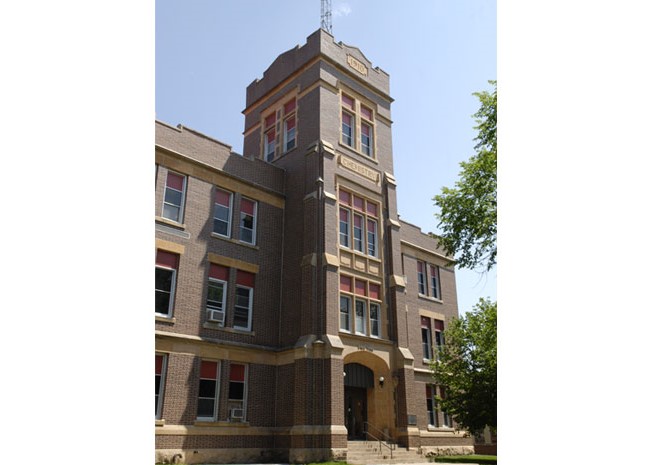
All research and most teaching activities within the department occur within three centrally-located buildings, including two connected facilities, Ladd Hall and Dunbar Laboratory, as well as the Quentin Burdick Building, located across the street.
Most departmental offices, classrooms and teaching labs, as well as some research labs are located in Ladd Hall, while Dunbar and the third floor of the Quentin Burdick Building primarily consist of research laboratories. Ladd Hall also houses departmental glass, machine, and electronics shops.
Modern instrumentation is vital to research in the chemical sciences. The quality and quantity of instrumentation within the department has been greatly enhanced in the last few years through aggressive fundraising efforts and university matching support.
The department has recently upgraded its mass spectrometry capabilities to include a Bio-TOF III with accurate mass analysis, ESI and CI ionization; as well as an Esquire 3000 Plus - an Ion trap instrument with MS-MS and proteomics capabilities. A dedicated LC can be integrated with the both the instruments.
The Organic Spectroscopy Laboratory is primarily devoted to maintenance and operation of Nuclear Magnetic Resonance (NMR) spectrometers. The facility includes three modern high-field instruments: Varian 500, 400, and 300 MHz spectrometers. All have multinuclear, 2- D, and variable temperature capabilities, and the 400 MHz instrument has been recently upgraded for solids capabilities. This center also includes the departmental FTIR.
The Materials Characterization Laboratory houses the departmental crystallography faculties including a Bruker single crystal CCD X-ray diffractometer with low temperature capabilities, a Philips MPD (Multi- Purpose Diffractometer), two Philips X-ray powder diffractometers, and a Kevex X-ray fluorescence unit. CHN Elemental analysis, thermogravimetric analysis (TGA), differential scanning calorimetry (DSC), and differential thermal analysis (DTA) are also available.
The Center for Protease Research - Core Biology Facility is a new facility housing equipment and technical personnel for performing bioassay, cell and tissue culture, and molecular biology experiments. For bioassays, the facility has a fluorimeter capable of top or bottom reading and the capability to handle both 96- and 384-well plates. For sample preparation, researchers can utilize cell and tissue culture capabilities such as flow hoods and culture chambers. In addition, RT-PCR and FPLC protein purification technology is available.
The chemistry library, located in Ladd Hall, provides graduate students and faculty with convenient 24-hour access to more than 200 journals and approximately 10,000 volumes. Literature searching via SciFinder is supported.
Prospective students are encouraged to visit the Department of Chemistry and Biochemistry website for the latest descriptions of research programs and instrumentation.
The graduate programs in chemistry are open to all qualified graduates of universities and colleges of recognized standing. To be admitted with full standing to the program, the applicant must meet the Graduate School's admission requirements, have adequate preparation for the study of chemistry at the graduate level, and show potential to undertake advanced study and research as evidenced by academic performance and experience.
Financial Assistance
The student must first apply to the Graduate School and be accepted in full or conditional status before he/she is eligible for an assistantship in the Department of Chemistry and Biochemistry.
Graduate students in the Department of Chemistry and Biochemistry are supported during both the academic year and during summer months by either teaching assistantships (TA) or research assistantships (RA). As of the 2014-2015 academic year, the standard stipend is $22,000 per year for both RAs and TAs. University tuition (no fees) is waived for all TAs and RAs in good academic standing.
Master of Science
The Master of Science program requires the completion of a total of 30 graduate semester credits with an overall GPA of 3.0 or better. This total is comprised of both class work and research credit, but must consist of at least 16 semester credits from letter-graded course work.
Course List | Code | Title | Credits |
| CHEM 720 | Introduction to Chemical Research | 2 |
| CHEM 790 | (second year seminar) | 1 |
| or BIOC 790 | |
| MICR 720 | Scientific Integrity | 1 |
| CHEM 790 | (defense seminar) | 1 |
| or BIOC 790 | |
| 16 * |
| CHEM 798 | | 6-10 |
| or BIOC 798 | |
| CHEM 632 | Analytical Chemistry II | 3 |
| CHEM 730 | Separations | 2 |
| CHEM 732 | Advanced Survey of Analytical Chemistry | 4 |
| CHEM 736 | Mass Spectrometry | 2 |
| BIOC 673 | Methods of Biochemical Research | 4 |
| BIOC 674 | Methods of Recombinant DNA Technology | 3 |
| BIOC 701 | Comprehensive Biochemistry I | 4 |
| BIOC 702 | Comprehensive Biochemistry II | 4 |
| CHEM 724 | Chemical Applications of Group Theory | 1 |
| CHEM 725 | Advanced Survey of Inorganic Chemistry | 4 |
| CHEM 727 | Organometallic Chemistry | 3 |
| CHEM 728 | Physical Methods for Chemical and Biomolecular Research | 2 |
| CHEM 744 | Organic Spectroscopy | 2 |
| CHEM 741 | Physical Organic Chemistry I | 4 |
| CHEM 742 | Physical Organic Chemistry II | 2 |
| CHEM 744 | Organic Spectroscopy | 2 |
| CHEM 745 | Organic Synthesis | 4 |
| CHEM 665 | Survey of Physical Chemistry | 4 |
| CHEM 760 | Statistical Thermodynamics | 4 |
| CHEM 763 | Kinetics | 2 |
| CHEM 764 | Dynamics | 2 |
Doctor of Philosophy
The Ph.D. program requires the completion of a total of 90 graduate semester credits with an overall GPA of 3.0 or better. This total is comprised of both class work and research credit, but must consist of at least 27 semester credits from letter-graded course work.
Course List | Code | Title | Credits |
| Introduction to Chemical Research | |
| Scientific Integrity | |
| Advanced Survey of Inorganic Chemistry | |
| Advanced Survey of Analytical Chemistry | |
| Physical Organic Chemistry I | |
| Advanced Survey of Physical Chemistry | |
CHEM 790 | (second year seminar) | |
CHEM 790 | (proposal seminar) | |
CHEM 790 | (defense seminar) | |
CHEM 899 | ( Number of research credits determined by student and supervisory committee) | |
| |
| 90 |
Additionally, the following departmental courses are available for students; Consult with committee for recommendations
Each student chooses a thesis adviser within six months of beginning graduate school. As this is one of the most important decisions made in graduate school, students are strongly urged to visit multiple faculty members to discuss research opportunities. In addition, faculty seminars during the fall semester are designed to acquaint new students with the available research programs.
By the end of the first academic year, each student selects an advisory and examination committee, which consists of the thesis adviser, two other faculty members in the chemistry department, and one faculty member from a department outside the Department of Chemistry and Biochemistry.
Admission to candidacy for the Ph.D. degree is accomplished by satisfying three requirements:
- satisfactory performance in course work with a minimum 3.0 grade point average,
- satisfactory performance in comprehensive examinations taken by the end of the 4th semester, and
- satisfactory defense of an original research proposal on a topic approved by the student's advisory committee.
The defense of this proposal must occur at least eight months prior to the final oral examination. Following completion of dissertation research, the candidate must complete a written dissertation and an oral presentation to the department and advisory committee.